
Code is Disposable, Domain is Your Only Asset in Age of AI
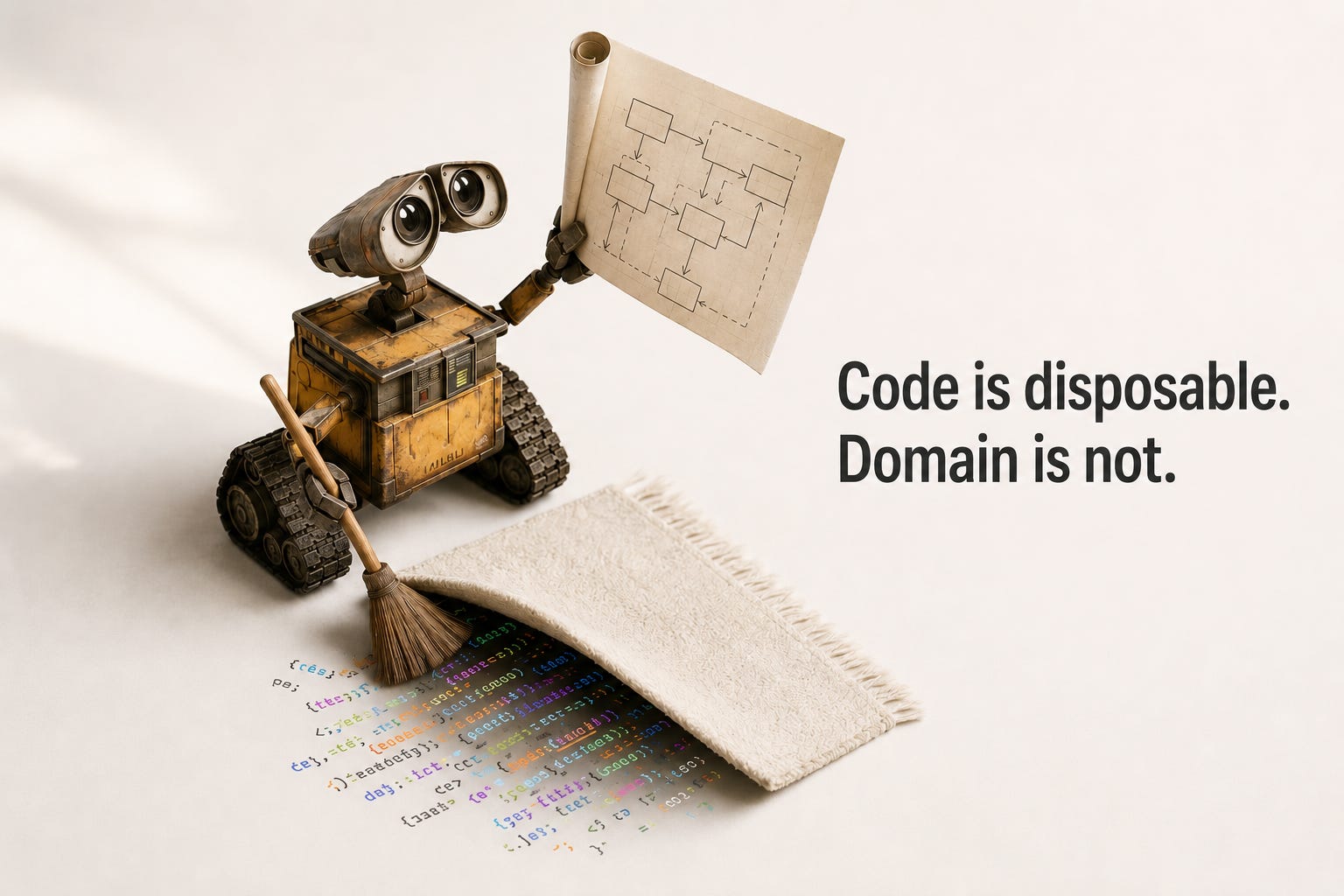
Your code is disposable. Your domain is not. You focus on the part that is in-disposable your domain first.

Code is quickly becoming the cheapest part of engineering.
Seasoned engineers know this. Code is a liability not an asset.
When velocity of code changes increases, it can be more disposable. Which is how it should have been in the first place.
That begs the question if code is dispensable, what isn’t?
It is your Domain, isn’t it.
If you can iterate on your domain faster and more precisely, that is your edge.
The bottleneck is no longer “can you write good code?“ anymore. It is “do you understand the domain deeply enough to know what code should exist in the first place?“
What is Moat in the Age of AI?
Defensibility is moving away from code and features toward domain expertise, proprietary data, and workflow integration.
What used to be the moat What is the moat now Code quality Domain understanding Feature set Unwritten business rules Technical architecture Proprietary data and workflows Implementation speed Knowing which problems are worth solving
The question is no longer about technical execution. It is about what you understand that the AI does not.
Question becomes What do you know about user’s problem that AI doesn’t and what battles you end up choosing.
There is one paradigm of engineering that serves this use case like champ. Domain Driven Design.
It’s like chess, earlier engineers used to be players. Now they need to think like game designers and give AI more creative control and let them be the players.
Going by my chess analogy, Rules of the game are rules of your domain.
DDD is the language we can use to define rules of the game.
Richer understanding of the processes and rules of a domain. Better your game play.
Your code can change like a shape shifting machine as long as your can define your domain in a language your AI can understand.
The question is whether you understand the domain well enough to know what the code should do in the first place.
What is Domain Driven Design?
Domain-Driven Design, introduced by Eric Evans in 2003. Evans wrote that the heart of software is its ability to solve domain-related problems for its user.
With a ubiquitous language, the model is not just a design artifact. It becomes integral to everything the developers and domain experts do together.
DDD is that language that sits between domain expert and the AI agent. It defines your domain.
If you can nail these definitions with DD. Code can be extremely disposable. You can build new systems and drop them like they are costumes.
The building blocks
DDD has a few core ideas. Once you get them, everything else falls into place.
Ubiquitous Language. The shared vocabulary between you and your domain experts. Not the technical jargon. The actual words the business uses to describe what they do. When everyone speaks the same language, ambiguity dies.
Entities. Things with identity. A customer is not just a record. It is a living concept with behavior, rules, and history. Two customers with the same name are still different customers.
Value Objects. Things defined by what they are, not who they are. A price. A date range. An address. You do not track them by ID. You replace them when they change.
Aggregates. Clusters of entities and value objects bound together under one root. The root is the gatekeeper. Nothing gets in or out without going through it. This is where your business rules live.
Domain Events. Things that happened. Order placed. Payment failed. User upgraded. They are facts, not instructions. And they are the backbone of how your system communicates with itself.
Bounded Contexts. Boundaries around specific parts of your business. In billing, a user is someone who pays. In shipping, a user is someone who receives a package. Without boundaries, you try to make one concept do everything and the model becomes a bloated mess. Bounded contexts keep each part clean, with its own language, its own rules, its own model.
These are not coding patterns. They are thinking tools. They force you to model the business before you model the database.
Before execution, you crunch knowledge
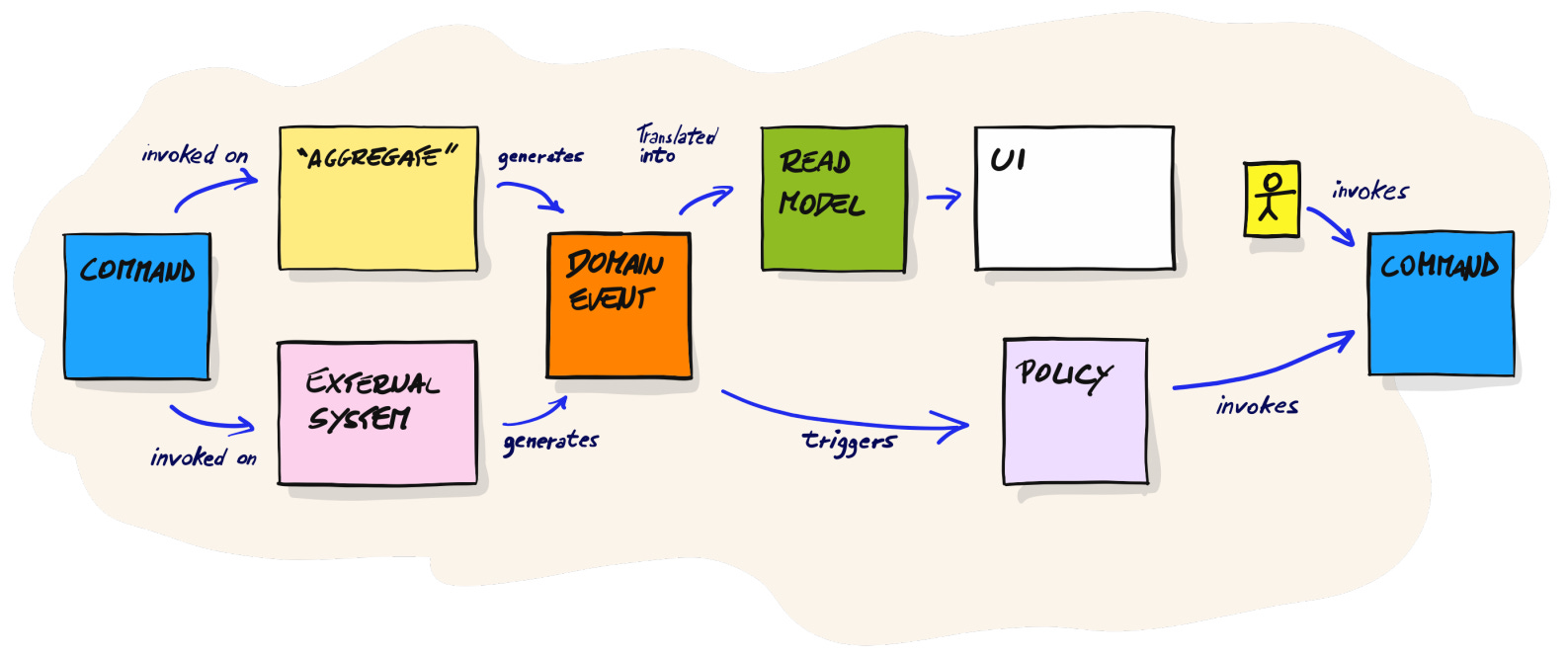
Evans coined the term “knowledge crunching” for the iterative process where developers and domain experts collaboratively distill deep understanding of how the business actually works.
This is where domain moats get built. Not in the code. In the understanding.
Event Storming is the most accessible entry point. It requires zero coding knowledge. Domain experts, product owners, and engineers sit around a whiteboard with sticky notes and map business events in plain language. The model is visual, event-based, and collaborative.
Strategic modeling goes further. It forces you to identify your core domain, the part of the business that makes you competitive.
Event storming is the process where you develop the constant blueprint that stays in between your disposable code refactors.
Your code is disposable. Your domain is not. You focus on the part that is in-disposable your domain first. Build the part that lasts between many code changes. The code will change. Like crazy it will, but the essence remains and everything still works.